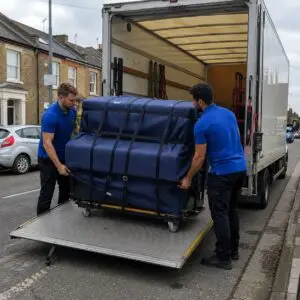

What really makes moving into a London new-build difficult?
A London new-build move usually depends on access, lift control, parking permission and the building’s move-in slot. The van can arrive on time and still sit outside if the concierge has no booking, the loading bay is locked or the goods lift has no protection fitted.

The access problem that starts before the van reaches the building
Picture the van outside a smart glass entrance, with the crew ready, the keys released and the flat waiting. Nothing moves because the loading bay needs a form, the concierge needs the removal company access details, or the barrier is controlled by building management.
Brochures show the entrance. Moving day uses the service route.
Managed apartment blocks can work like controlled sites. Fobbed doors, basement ramps, contractor sign-in, service corridors and delivery routes can all sit between the van and the flat. “Secure development” sounds reassuring during a viewing, but on London new-build moving day it can mean nobody opens the first door until the right person has approved the move.
Canary Riverside, a real London managed development, asks residents to tell the concierge the planned arrival or departure date and time for both the resident and the removal company. Its guidance says that this helps arrange access and spot issues such as loading bay access, bulky items, site restrictions and scheduled goods lift maintenance. It also says loading bay access requires a completed booking form.
Completion day or tenancy start proves that you can occupy the home. It does not prove that the building is ready for removals access. Before moving into a managed apartment block, the useful question is simple: who controls every point between the road and the flat?
Why the lift booking is more than a lift booking
A lift booking only works if the right lift is available, protected and under the control of the right person. A verbal “yes, there is a lift” does not tell you whether furniture can actually travel through the building.
Passenger lifts, goods lifts and service lifts can have different rules. Some buildings use a lift hold key, some need lift curtains or lift protection, and some will not allow bulky furniture through a resident lift at certain times. A sofa beside a lift that cannot be held open is a problem. It slows the carry, increases the risk of knocks and can block other residents.
GT Removals usually checks lift details before move day where they affect access, because a badly booked lift can stall an otherwise well-planned flat move. Canary Riverside’s guidance gives a useful real example of how detailed this can be. Its concierge can prepare the goods lift and provide a lift hold key so lift doors can stay open for loading.
Before you rely on a lift booking, confirm these points:
- Which lift is booked. Ask whether removals must use a goods lift, service lift or passenger lift.
- Who controls the key. Confirm who releases any lift hold key and where the crew collects it.
- What protection is fitted. Ask whether lift curtains, padding or other protection must be in place first.
- How long the slot lasts. Check the start time, end time and whether another resident or contractor follows you.
- Whether maintenance is planned. A lift slot is no use if the lift is booked for servicing at the same time.
Furniture dimensions matter as well. A bed frame, wardrobe or sofa can fit inside the flat and still fail at a lift turn, lobby corner or service corridor. Measuring the lift is helpful, but measuring the route into and out of it is better.
An employed team, published pricing, and full insurance on every job, from a single item to a full house.
Get a Free QuoteThe parking rules that decide whether unloading can start
Parking rules for removals vans vary by street, borough and land ownership. A space outside the building may be controlled by the council, by Transport for London, by the managing agent or by nobody useful at all.
A borough-controlled resident bay is different from a private loading bay inside a development. A yellow line is different from a red route. A delivery bay may allow short loading but still be wrong for a full flat move. Hazard lights do not turn a bad stopping place into a legal unloading plan.
Parking rules and charges can change by authority, so treat this as general information, not professional advice.
For a concrete London example, the City of London Corporation says it needs six working days to process a parking bay suspension and three working days to process a parking dispensation. Its guidance says a dispensation can allow a vehicle to stand on a single yellow line, or in special cases on double yellow lines, where it needs to stay close to a premises for loading or unloading for longer than the usual permitted time.
Those rules do not apply across every London borough. They show the kind of notice and permission that may be needed. The City of London Corporation also warns that a Penalty Charge Notice may be issued if loading restrictions are in force, the vehicle is on the footway, loading or unloading is not continuous, or the vehicle is left unattended.
Useful planning starts with one plain distinction: the borough council parking team controls some spaces, building management controls others, and red routes sit under a separate traffic system. Find the controller before you plan the unloading.

Ask the managing agent for the exact route from the van to the flat, including any fobbed doors and service corridors, before move day arrives.

Why the move-in time slot can control the whole day
A new-build move-in slot can control the van, lift, loading bay and crew timing at once. Missing that slot may matter even if the removals team has arrived on time elsewhere.
Consider a common London sequence. Keys come through later than expected, the lift slot at the new building started earlier, and another resident is booked after lunch. The van has not failed. The schedule has collided with the building diary.
Managed blocks use time slots because access is shared. Concierge teams may be coordinating contractors, deliveries, lift protection and loading bay access in the same period. Canary Riverside’s move guidance again shows the point. Residents are asked to give the planned arrival or departure date and time for both themselves and the removal company.
Keys and access are separate things. A new-build handover may confirm that the flat is yours to enter, but the loading bay can still need approval and the goods lift can still be assigned to another booking. A realistic plan works backwards from the building’s slot, then allows room for ordinary delays at the old address.
The hidden carry distance inside a secure development
The distance that matters is the route from the van to the room where each item lands. A loading bay at the building does not always mean a short carry.
One route might run from a basement bay, up a ramp, through a fobbed door, along a service corridor, into a lift, across another corridor and then through the flat door. Another might start at a front entrance but turn sharply before the lift. Neither route looks difficult on a postcode, yet both change how long the move takes.
Long carries affect more than time. Heavy items need the right trolley route, door widths need checking, and fresh walls or floors may need extra care at tight turns. Small items multiply the issue because every box travels the same route as the sofa.
A floor number and address are not enough for accurate flat removals access. Walk the internal route if you can, or ask the concierge to explain it in plain terms: where the van stops, which doors need fobs, which lift is used and how far the flat is from the lift doors.
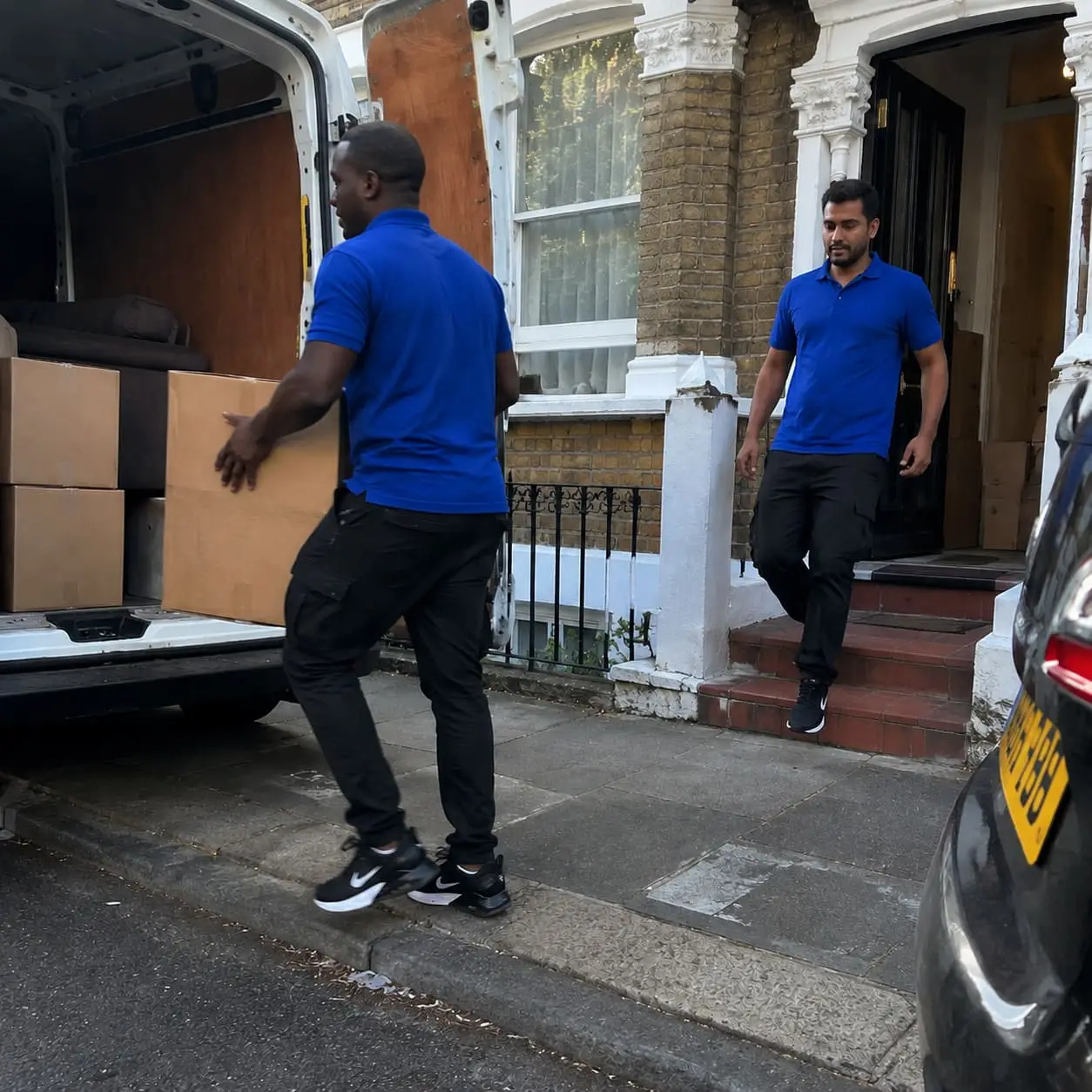
Check whether the booked lift can handle bulky items at the same time as resident traffic, because a shared slot can slow the whole move.

Why new communal areas make damage and liability a moving-day issue
New communal areas make building damage a real moving-day concern. The risk includes your belongings, the shared parts of the building and any marks already inside the flat.
Managing agents often care closely about fresh walls, lift interiors, door frames and floors. That does not make them difficult. It means they are protecting finishes that many people use and that can be marked during a busy move. If lift curtains or floor protection are required, confirm that before the first item leaves the van.
Keep three records separate. Your belongings are covered by goods in transit insurance, which relates to items while they are being moved. Building damage sits under public liability insurance, which relates to damage to property or injury to others during the work. Existing flat defects belong on your snagging list and should be recorded before boxes cover the floor.
GT Removals carries £30,000 goods in transit insurance and £5 million public liability insurance on every job. That does not remove the need for care, photographs or building rules. It gives a clear framework if a question arises about belongings, communal areas or a pre-existing snag.
The London charge-zone costs that brochures leave out
Central London new-builds can involve charge-zone costs as well as access and parking rules. The building postcode tells you where the flat is, but it does not show what the van must pass through to reach it.
Transport for London says the Congestion Charge is £18 if paid on the day of travel or in advance, and £21 if paid within three days after travel. TfL also says the charge operates from 07:00 to 18:00 Monday to Friday, and from 12:00 to 18:00 on Saturdays, Sundays and bank holidays, with no charge from Christmas Day to New Year’s Day bank holiday, inclusive.
Electric vehicle assumptions need care too. TfL says the previous 100% Cleaner Vehicle Discount has ended. Electric vans, HGVs and quadricycles registered on Auto Pay can receive a 50% discount, making the daily charge £9 instead of £18.
For central London flat moves, ask early whether any Congestion Charge zone cost is already included in the agreed moving price. Old figures and old exemption assumptions can make a quote look clearer than it really is.

Call, fill in the form, or send a few photos on WhatsApp and most quotes come back within a few hours.
Get a Free QuoteThe final checks that turn a new-build move from hopeful to controlled
A good London flat move starts by identifying who controls each part of the route. The key checks are access, lift, parking, timing, internal distance, protection and charges.
Use this final check before the van is due:
- Building access. Confirm who approves the move, who opens barriers and which details the concierge needs.
- Lift use. Confirm the lift type, booking time, key control, protection and any maintenance.
- Parking. Identify whether the space is council controlled, privately managed, a yellow line or a red route.
- Timing. Match the van arrival to the building’s move-in slot, not just the key release time.
- Internal route. Check the route from loading bay or street to flat door, including fobbed doors and corridors.
- Protection and records. Photograph existing snags, ask about communal protection and keep damage issues separate.
- Charges. Check any Congestion Charge zone cost and avoid relying on old assumptions.
Once these points are checked, the move looks different. The address is no longer a single destination on a booking form. It becomes a controlled route with named gatekeepers, timed access and known weak points. That shift matters because moving day usually stalls at the place nobody checked: the locked bay, the lift key, the parking space or the corridor between them.
Frequently asked questions
Do you need to book a lift when moving into a flat?
Most managed blocks expect lift use to be arranged before removals begin, especially if furniture is bulky or shared lifts are involved. Ask which lift must be used, who controls any lift hold key and whether protection is needed.
Can building management stop removals using the lift?
Building management can set rules for how lifts and communal areas are used. If the lift has not been booked, protected or approved for removals, the move may have to wait until the right permission is in place.
How do I arrange parking for a removals van in London?
Start by finding out who controls the space outside the building. A council bay may need a parking bay suspension, a yellow line may need a dispensation, and a private loading bay may need approval from building management.
Should I do a snagging list before moving into a new-build flat?
A snagging list is best recorded before boxes and furniture fill the flat. Photographs help separate pre-existing defects from any damage concerns that arise during the move.
Can a removals van stop on a red route in London?
Red routes have their own stopping and loading rules, so never assume a removals van can stop there. Check the signs and the relevant authority before moving day, because a convenient space can still carry a parking risk.