Which items are most often damaged in self-packed boxes?
The items most often damaged in self-packed boxes are plates, glasses, mugs, screens, lampshades, framed pictures, bottles, toiletries, books and heavy kitchenware. Breakage usually comes from movement inside the box, poor weight spread, weak cardboard, hard items touching fragile ones, or liquids leaking into absorbent belongings.
Box Failure Patterns
Careful packing does not always mean safe packing. Many damaged moving boxes were packed with good intentions, but the wrong problem was solved.
A box can look tidy when it leaves the kitchen table and still fail on the stairs. Movers notice clues fast: crushed corners, weak seams, rattling voids, damp box bottoms, overfilled cartons and heavy items pressing into lighter ones. Those signs often explain why things break during a move better than the item itself.
Packing has four separate jobs:
- Bottom cushioning. The base needs enough protection to absorb pressure from lifting and setting down.
- Side clearance. Items should not sit tight against box walls or corners.
- Void fill. Empty space needs filling so belongings cannot shift.
- Item separation. Each piece needs protection from the next piece, especially with glass, china and hard edges.
FedEx packaging guidance says void spaces should be filled to stop goods moving inside the box, and individual items should be wrapped and centred away from the sides, corners, top and bottom. FedEx also says markings such as “Up” arrows cannot be relied on, so the packing must work even if the box is tilted.
That point matters in London flats. A box may travel down narrow stairs, through a lift lobby, across a pavement and into a van parked away from the door. A fragile label can warn people to take care, but it cannot stop a mug handle tapping a glass rim for the whole carry.
Plates And Bowls
Plates and bowls usually break because pressure travels through the stack. The common mistake is packing them as though they will stay level in a cupboard.
A neat stack of plates feels safe because each plate supports the one above it. During a move, the carton gets lifted, tilted, carried and set down. Flat plates can then take pressure through their faces, and a small knock at the edge can turn into rim chips or pressure cracks.
What went wrong: the plates were wrapped, but the stack was still allowed to behave like one heavy block.
For moving house, plates are usually safer packed standing up on their edges, with cushioning at the bottom and packing paper around each one. Bowls need the same thinking. Nested bowls may look snug, but the rims still need separation because they can grind against each other when the box moves.
FedEx packaging guidance gives a useful benchmark for spacing: a box should allow 2 to 3 inches of cushioning on all six sides. For kitchenware, that means the top pad alone is not enough. Side gaps also need filling, because a full-looking box can still slide sideways if the contents are not locked in place.
Pans, mugs and food jars should not sit above plates as a way to use spare space. Heavy kitchen items turn a tidy dish box into a pressure point, especially when the carton is stacked in the van.
Full, partial, or materials-only packing from the same team that moves you.
Get a Free QuoteGlasses And Mugs
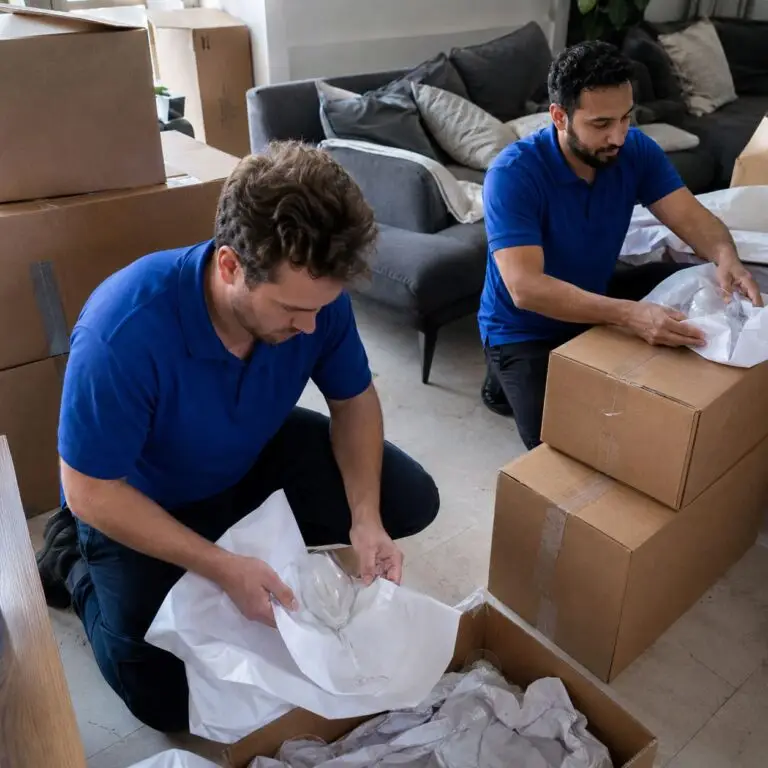
Glasses and mugs break from contact as much as from impact. Bubble wrap around the outside will not save them if the items inside can still knock together.
Picture six mugs wrapped as one bundle. The outside feels padded, but the handles can still meet each other inside the parcel. During lifting and van movement, those handles become small levers, and the first crack often appears where the handle joins the mug.
Glassware has several weak points:
- Rims. Thin edges chip when they touch another hard edge.
- Handles. Mug handles snap when they are squeezed or knocked sideways.
- Stems. Wine glass stems need separation from bowls and bases.
- Bases. Thin glass bases can crack if pressure comes from below.
Surface protection and impact protection are different things. Packing paper can stop scratches and light rubbing, but it does not replace separation between items. Bubble wrap can help, but it needs to be used around each item, with void fill around the group.
For fragile glassware, double-boxing can be sensible where the item is especially vulnerable. FedEx guidance says fragile items should be double-boxed with 3 inches, or 8 cm, of cushioning in and around the smaller box. For normal mugs and glasses, the practical lesson is simpler: if the box clinks when nudged, the contents are still moving.

Screens And Electronics
Screens are often damaged by pressure, twisting or loose accessories, rather than one dramatic drop. A TV or monitor needs its corners, face and position protected.
Original packaging is useful because it holds the screen in a fixed shape. Without that support, a screen face can press against a box wall, or a corner can take the force of a tight turn through a hallway. Blankets may protect the surface from marks, but they do not always stop flexing or corner pressure.
Cables, plugs, remotes and power leads create another risk. A plug packed loose beside a monitor can scratch the screen or press into the frame. Accessories should be bagged and kept away from the screen face, or packed in a separate section where they cannot move into the panel.
GT Removals‘ terms place responsibility on the customer to prepare and stabilise appliances or electronic equipment before removal. In plain terms, owner-packed electronics should be made ready before moving day, with loose parts secured and the item supported so it cannot shift inside its box.
A useful test is to look for pressure points before sealing the box. If a cable plug, remote or hard corner can touch the screen when the box is tilted, the packing still has a fault.
Pack plates and bowls so they cannot behave as one rigid stack. If the box feels solid when you lift it, the contents may still be shifting inside.

Lampshades And Artwork
Light items fail when people mistake low weight for low risk. Lampshades, framed prints and small decorative pieces are often damaged by compression, not by heaviness inside their own box. A lampshade may weigh very little, but it can puncture or bend if it shares space with a hard ornament or sits beneath heavier cartons. Framed pictures have a similar problem: the surface may be wrapped, yet the corners and glass front can still take pressure if the box has no rigid support.
Use a different packing rule for hollow or shape-sensitive items:
- Support the shape. Give lampshades and light decorative items space so they are not squeezed.
- Separate the box. Avoid mixing soft or hollow pieces with books, jars or tools.
- Load near the top. Mark the box clearly, but also make it obvious from the packing that it should not carry weight.
- Keep hard objects out. A small metal or ceramic item can puncture a shade during a short carry.
A box of soft home decor should feel protected from pressure, not just wrapped from scratches.

Bottles And Toiletries
Some damage starts as a leak, not a break. One loose shampoo cap or cracked jar can ruin clothes, books, paperwork and the box itself.
Leaking bottles create a chain reaction. Liquid softens cardboard, the bottom sags, and the carton becomes harder to carry. Absorbent items then hold the stain or smell, even if the bottle itself survives the move.
Toiletries, cleaning bottles and jars need containment. Lids should be tightened, openings should be sealed where practical, and liquids should sit upright inside a bag or small inner container. Absorbent belongings should go elsewhere, especially books, documents, bedding and clothing.
Some items also need checking before they go anywhere near a removal box. GT Removals’ terms say certain items must not be submitted for removal or storage unless agreed in writing first, including potentially dangerous, damaging or explosive items such as gas bottles, aerosols and paints, plus plants, perishable items, animals, birds and fish. For an ordinary bathroom or kitchen box, the safe habit is to separate liquids from anything that would be spoiled by a leak.
Keep toiletries and liquids in their own sealed section. A small leak can weaken cardboard and damage absorbent items before the box reaches the van.

Books And Heavy Kitchenware
Books, cast iron pans and food jars are not fragile in the usual sense, but they cause many box failures. The item survives, and the container gives way.
Packing to save boxes often means filling one large carton with anything heavy. Packing to survive the move means asking whether the base, seams and handles can cope when the box is lifted from a floor, carried down stairs or moved across a long hallway. A box can be packed neatly and still be awkward enough to drop.
The Health and Safety Executive says UK law does not set a specific manual handling weight limit. Risk depends on the task, the load, the working space and the person handling it. Carrying distance, stairs, floor surfaces and the nature of the load all matter, which is why a heavy box in a small flat can be a bigger problem than the same contents split across smaller cartons.
Supermarket boxes are not automatically wrong, but condition matters. FedEx says reused boxes should not be crushed, torn, punctured or otherwise damaged. For moving, weak bases and softened corners are warning signs, especially when the contents are books, pans or jars.
Keep heavy items low, spread them across smaller boxes, and do not hide fragile items underneath them. A mixed kitchen box with pans, jars, mugs and plates may save time at packing, but it creates pressure points that the fragile items cannot resist.
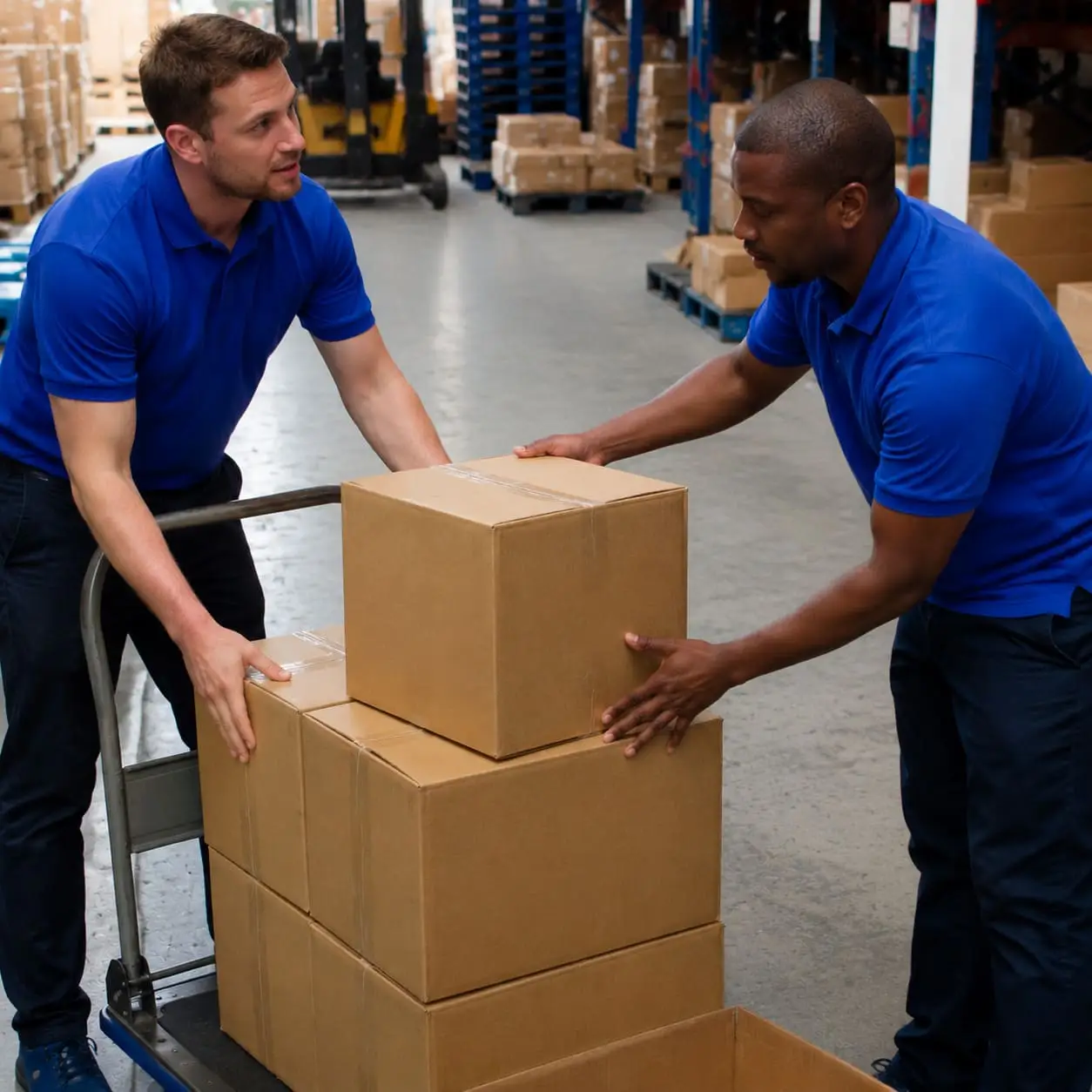
Self-Packed Box Liability
Removals insurance does not always mean self-packed boxes are covered in the way customers expect. Liability can change when the mover did not pack or unpack the container.
The reason is simple. If nobody saw how the item was wrapped, separated or placed in the box, it becomes harder to prove whether the damage came from handling or from packing quality. Goods in transit cover deals with belongings while they are being moved, but unknown packing inside a sealed carton is a separate issue.
The terms say that when the mover has undertaken to pack goods, the responsibility is to deliver them in the same condition they were in immediately before being packed or made ready for transport or storage. That is very different from a sealed owner-packed carton where the packing method cannot be checked.
Several points matter for self-packed boxes. The terms define an “Item” as the entire contents of a box, parcel, package, carton or similar container, or any other object moved, handled or stored. Under Limited Liability, liability is capped at £40 per item where loss or damage is caused by negligence or breach of contract. The terms also say goods in wardrobes, drawers, appliances, packages, bundles, cartons, cases or similar containers are not covered unless they were both packed and unpacked by the mover.
Fragile items have a separate risk. China, glassware and fragile items are excluded unless they have been both professionally packed and unpacked by the mover or its subcontractor. If an accident involves an owner-packed container and the damage would have happened regardless of packing quality, liability is limited to £100 or the actual value, whichever is less.
Claims timing matters too. Damage claims must be notified in writing as soon as discovered and within seven days of delivery. Anyone self-packing fragile items should read the terms before moving day, because the packing decision can affect the claim position later.
Let our team wrap and box your belongings so everything arrives safely.
Get a Free QuoteThe Packing Judgement Shift
A good moving box is not the one that looks full. A good moving box is the one that can be lifted, tilted, stacked and carried without the contents changing position.
Before sealing a carton, judge the box by what would make it fail:
- Lift test. The box should be manageable from floor height without straining, twisting or feeling unstable.
- Rattle test. The contents should not clink, slide or knock when the box is gently moved.
- Pressure test. Fragile pieces should not sit under hard or heavy items.
- Leak test. Liquids should be sealed, contained and kept away from absorbent belongings.
- Strength test. The base, seams and corners should be sound before the box is packed.
Fragile stickers, neat tape and extra bubble wrap all have a place, but none of them fix poor weight spread, loose contents or a weak carton. The better question is no longer “Have I packed this?” The better question is “What would make this box fail between the flat and the van?”
Once that changes, self-packing feels less like guesswork. You can see the weak seam, hear the rattle, spot the hard object beside the glass, and remove the leak risk before the box ever leaves the room.
Frequently asked questions
Should plates be packed flat or standing up?
Plates are usually safer packed standing up on their edges, with cushioning underneath and wrapping around each plate. Flat stacks can transfer pressure through the plates when the box is lifted, tilted or stacked.
Is bubble wrap enough for glasses and mugs?
Bubble wrap helps, but it is not enough if glasses or mugs can still touch each other. Each item needs separation, and empty space inside the box should be filled so the contents cannot clink or shift.
Can I use supermarket boxes for moving house?
You can use reused boxes if they are sturdy, dry and undamaged. Avoid boxes with crushed corners, torn sides, punctures, weak seams or softened bases, especially for books and kitchenware.
Are movers responsible if something breaks in a box I packed myself?
Responsibility depends on the mover’s terms and the cause of the damage. Self-packed boxes can be harder to assess because the mover did not see how the contents were wrapped, separated or supported.
Do fragile stickers protect items during a move?
Fragile stickers help communicate that a box needs care, but they do not replace proper packing. A box should protect the contents even if it is tilted, carried a longer distance or placed with other cartons.