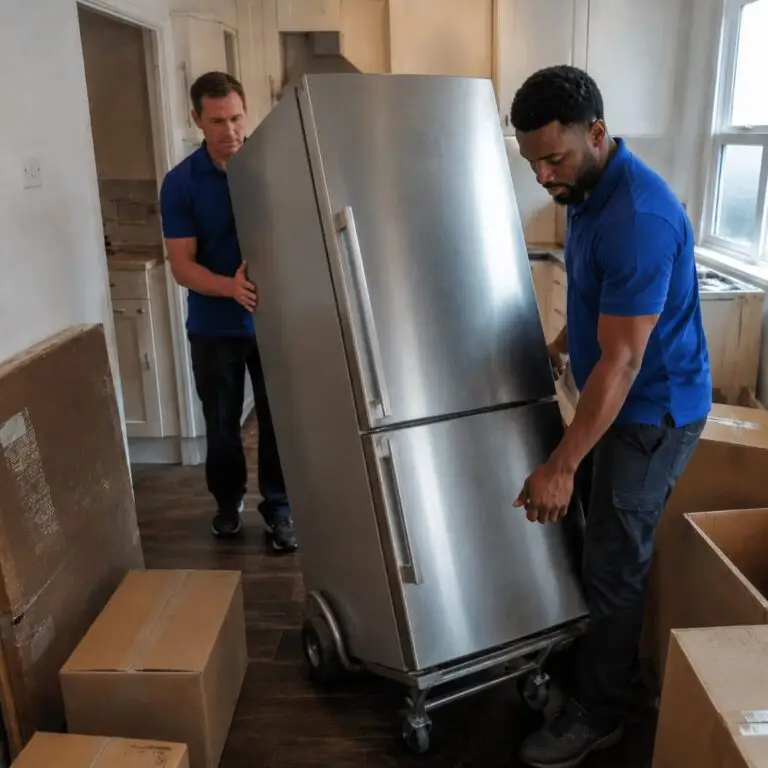
What is the safest way to move a fridge or freezer?
The safest way is to empty it, defrost it, secure the loose parts, keep it upright where possible, strap it firmly in the van, then wait before switching it back on. We treat the job as a sequence, because most damage comes from rushing one small step.
A safe move follows a set order
A fridge or freezer move goes wrong when people treat it like any other heavy box. Strength matters, but order matters more. You need the appliance ready before lifting, the route clear before moving, and the van set up before loading.
We use this sequence because it keeps the main risks under control:
- Empty the appliance before anyone moves it. Food, bottles, drawers and shelves all add weight and movement.
- Defrost the freezer in good time. Meltwater on moving day creates mess and slipping risk.
- Dry the inside and secure loose parts. Shelves, drawers, door seals and the power cable need to stay put.
- Plan the route from kitchen to van. Check doorways, stairs, lifts, floor protection and parking before the appliance leaves its space.
- Move it upright where possible. Use a sack truck or appliance trolley, moving blankets and heavy-duty straps.
- Strap it inside the van. Upright transport still needs proper van strapping points and enough loading height.
- Let it stand before switching on. The waiting time depends on how it travelled and what the manufacturer’s user manual says.
Fridges and freezers share the same handling risks, but a freezer adds one extra issue: food. A frozen load cannot be treated as if it will look after itself all day, especially during a London move with stairs, building access rules or parking a short walk from the door.
Two parts deserve more care than most guides give them: what position the appliance travels in, and how you control the route from the kitchen to the van.
Upright transport is the safest default
Keeping the appliance upright is the aim. Bosch UK advises moving a fridge freezer upright where possible, and that matches how we plan these jobs in practice. Upright transport reduces the chance of oil moving away from the compressor, which is the part people worry about damaging after a tilt or a side move.
Upright transport is the safest default
A fridge or freezer has parts inside that are made to work in a fixed position. The refrigerant, which is the cooling fluid, and oil around the compressor are the reason position matters. You do not need to know the engineering, but you do need to respect the way the appliance is meant to stand.
Manufacturer guidance beats moving folklore. If your user manual gives a specific transport position or waiting time, follow that first. General advice online can be too blunt, especially the repeated claim that every fridge always needs exactly 24 hours before use.
A practical point follows from that. Plan the vehicle before you unplug the appliance. If the van is too low to carry the fridge freezer upright, you have already made the job harder before lifting starts.
Side transport needs a proper wait
Side transport is a fallback, not the plan. If a fridge or freezer has to be laid on its side, Bosch UK says it should stand upright for at least 3 hours before being plugged in and switched on. If it was left on its side for more than a day, Bosch says it should stand for 24 hours before being plugged in.
Back transport is different. Bosch UK says not to transport or lay a fridge or freezer on its back, because parts can be damaged even when the damage is not visible. If your appliance has to go on its side, Bosch also says the process tubes should be on the upper side. Process tubes are small service pipes linked to the cooling system, and your manual is the place to check the right side for your model.
The moving-day lesson is simple enough. Measure the route, measure the vehicle height, and decide the transport position before the appliance is unplugged.
If your fridge or freezer is part of a bigger move, send us a few details and we will give you a fixed price. We can also advise on access, parking and the safest way to load it.
Get a quotePreparation prevents leaks, loose parts and food problems
Many fridge and freezer moves start to fail before anyone lifts the appliance. The usual cause is small preparation left until the van is waiting outside.
Empty the appliance first. Bottles and jars make a fridge heavier, and drawers or glass shelves can shift inside if they are left loose. Bosch UK advises removing items, switching the appliance off, disconnecting it from the mains, and removing or taping drawers so they cannot move inside. Tape needs to hold parts steady without pulling at seals or leaving marks on surfaces.
Freezers need more planning because frozen food changes the timing. The Food Standards Agency says a fridge should stay cold for up to 4 hours during a power cut, while a full freezer should stay frozen for up to 48 hours and a half-full freezer for up to 24 hours, if the doors are kept closed. Those figures help you plan, but they are not a reason to keep opening the door during the move.
Use a cooling bag and ice packs for food you plan to keep. Normal fridge temperature guidance also matters: the Food Standards Agency recommends keeping fridges at 5°C or below in everyday use, so food should only go back once the appliance is running properly again.
Defrosting is the part people most resent doing, and it is also the part that saves the most mess. Meltwater in a van, a hallway or a lift turns a small delay into a practical problem. By the time the removal team or your helpers arrive, the appliance should be empty, dry, unplugged and ready to move.
Measure the appliance and the narrowest part of the route before moving day. A few minutes with a tape measure can save a failed lift at the front door.

The route from kitchen to van causes most damage
A fridge freezer can be prepared perfectly and still get damaged on the first tight turn. In London, the hard part is often the building, not the appliance: a narrow hallway, a stair turn in a converted house, a small lift, or a controlled parking zone that leaves the van too far from the entrance.
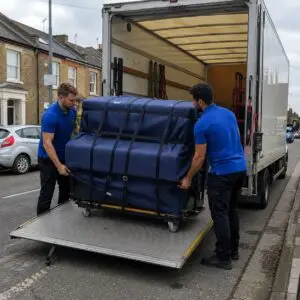
At GT Removals, we look at the route before we look at the lift. A proper sack truck or appliance trolley with straps is very different from a light household trolley. One is made to control a tall, heavy appliance. The other can leave you fighting the weight at the worst point on the stairs.
Before lifting, check the route like this:
- Doorways and turns: Check the kitchen door, hallway bends, front door and any tight stair turn before moving the appliance.
- Floors and edges: Use floor protection where the appliance will roll or pivot, especially on hard flooring and thresholds.
- Lift and stair access: Make sure the appliance fits without forcing it against walls, skirting boards or lift doors.
- Van position: Get the vehicle as close as the street and parking rules allow, because long carries increase mistakes.
- Loading setup: Confirm the van has height, space and strapping points for upright transport.
Bosch UK advises using floor protection, not moving the appliance in a zigzag motion, using a sack truck, and not lifting the appliance alone. That advice matters in real homes, where cracked handles, scraped doors and marked floors usually come from twisting, dragging or changing plan halfway through a tight gap.
Controlled movement looks slower at first. In practice, it saves time because nobody is trying to recover from a bad angle halfway down a communal stairwell.
Keep the appliance upright in the van and secure it with proper straps. Even a short journey can cause problems if it is allowed to shift or tilt.

DIY moving is sensible only when the route is simple
Can you move it yourself? Yes, if the appliance is manageable, the route is clear, the van can take it upright, and you have the right trolley and straps. Once stairs, long carries, awkward parking or side transport enter the job, a removals or man and van team becomes the safer choice.
Here is the fair way to judge it.
| DIY may be workable | Use a removals or man and van team |
|---|---|
| Ground-floor move with a short, clear route | Stairs, tight turns or a long carry to the van |
| Vehicle has enough height for upright loading | Appliance would need to travel on its side because of van space |
| Proper appliance trolley and straps are available | Only a light trolley or improvised lifting is available |
| Two capable helpers can control the weight | One person is expected to manage most of the lift |
| You can protect floors and doors properly | Shared halls, lifts or building rules add pressure |
At GT Removals, we handle man and van bookings and single-item moves with our own employed, trained team, not subcontracted strangers. For appliances, that matters because the job depends on equipment and control: a sack truck or appliance trolley, moving blankets, heavy-duty straps and a van that can take the item safely.
Insurance matters too, because reducing risk is not the same as promising nothing can ever go wrong. Our jobs include £30,000 goods in transit insurance, which means the appliance is covered while it is being moved on the van. Public liability insurance also matters where shared hallways, floors, doors and building areas are involved.
The right decision is the one that gives you control over the move, not guesswork at the heaviest point.
Switching on is part of the move
The appliance may be in the new kitchen, but the job has not finished yet. A fridge or freezer still needs to be upright, correctly positioned, checked over and left for the right settling time before it goes back into use.
Start with the manufacturer’s user manual. The waiting time depends on how the appliance travelled, especially whether it stayed upright or had to go on its side. Plugging it in too soon is the step people rush, usually because the food plan was poor or the move has already overrun.
Position matters before the switch goes on. Check that the appliance stands level, the doors close properly, the shelves and drawers are back in place, the cable is not trapped, and the socket is safe to reach. Leave the ventilation space the manual asks for, because a fridge freezer pushed tightly into the wrong gap has a harder job once it starts running.
Food goes back last. If the appliance has stood correctly, switched on without obvious problems and started to cool as expected, then you can restock it in line with your food plan. A careful move is the one where you can see the route, position, waiting time and food safety were handled in order. Once you know those checks, the job stops feeling like a gamble and becomes a controlled move with clear signs to look for.
For a one item move, our team can collect, load and deliver your appliance with the right equipment. It is a simple way to avoid damage when the route is awkward or the item needs careful handling.
Book man and vanQuestions we get asked about moving fridges and freezers
Can one person move a fridge with a trolley?
One person should not lift a fridge freezer alone. A trolley helps with control, but the appliance still needs steady handling, route control and help at turns, thresholds and stairs.
Should fridge doors be taped shut when moving?
Fridge doors can be secured for transport, but tape should not damage the seals or finish. We prefer securing doors and loose parts in a way that stops movement without pulling at the appliance.
Can you move a fridge with food still inside?
We recommend emptying it. Food adds weight, can spill, and can make it harder to keep the appliance clean and stable during transport.
What happens if you switch a fridge on too soon after moving?
Switching on too soon can cause problems if the appliance has been tilted or laid down and oil has moved away from where it should be. Let it stand upright for the time set by the manual before use.
Does a freezer need to be fully defrosted before moving?
A freezer should be defrosted and dried before moving where possible. That stops meltwater leaking into the property or van and makes the appliance easier to handle.
This is general information, not professional advice.