

Can you really move your office without losing a working day?
Yes, many small and medium offices can move without losing a working day if we plan the move around your trading hours, building access, information technology (IT), labels and testing. The aim is simple: staff leave one office ready to close down and return to another office ready to work.
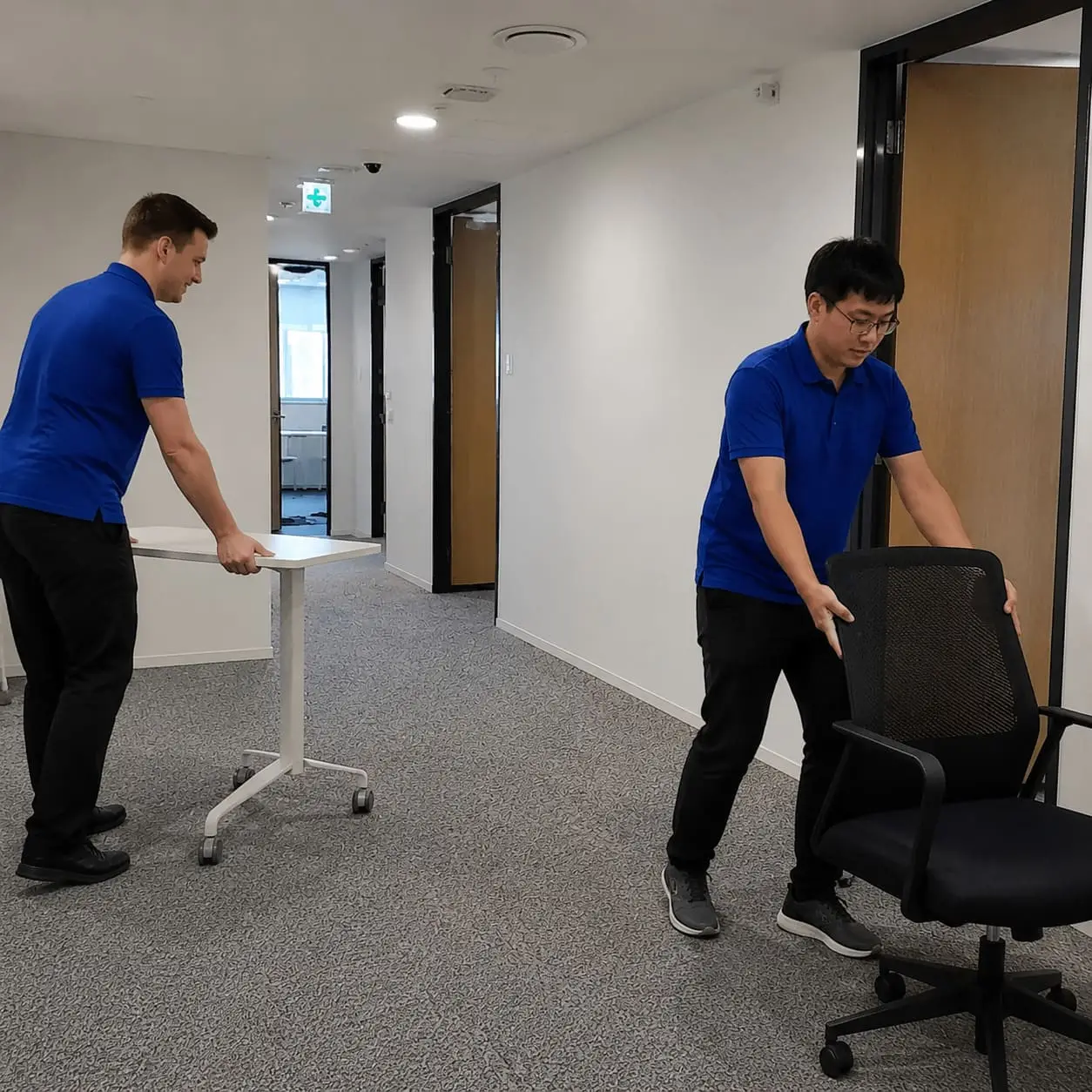
Treat the move as an operational plan
A common mistake is booking the van first, then finding out that the IT provider, parking, lifts and desk plan have not been lined up. By that point, the move has already started to put the working day at risk.
We start with the way your business needs to keep running. Some offices can close on Friday and reopen on Monday after a weekend office move. Others need an evening move, a phased move by team, or a short handover window where a few people keep working from another location. Your first decision is the business continuity plan, not the moving date.
Moving furniture into the new office does not mean the office is ready. Staff need their desks, screens, phones, files, shared equipment and logins in the right place before work begins. A floor plan and desk plan matter because they turn a pile of crates into a working office.
One working day can still be unavoidable where building access is restricted, IT work has to be done by a third party, lease timings do not line up, or staff need a controlled handover. That does not mean the move has failed. It means the office relocation plan needs to be honest about what can be done outside trading hours and what cannot.
Downtime is usually caused by missed planning gaps, not the lifting itself. We plan the gaps before anyone starts carrying desks.
We move evenings and weekends at no extra charge, so your team does not lose a working day.
Request a QuoteRemove the downtime traps early
Downtime often starts before move day because small loose ends get left for the first morning back. The office looks moved, yet people cannot work because the printer is not connected, a laptop charger is in the wrong crate, or the new desk plan does not match the labels.
The main traps are practical and avoidable:
- IT treated as a small task. Computers, monitors, phones, network kit and server equipment need planned disconnection, packing, reconnection and testing.
- Vague crate labels. A label saying “accounts” is weaker than one that gives the destination floor, desk number, owner and priority.
- No agreed desk plan. If the destination office is open plan, each item needs somewhere to land before the van is loaded.
- Files packed like normal stationery. The Information Commissioner’s Office expects organisations to know where physical records are and to track movement between storage and office areas, so confidential files need controlled handling.
- Staff unsure what to do. People need to know what they pack, what stays out, what must not be touched, and where they report when the new office opens.
- Phone lines and shared kit left until the end. Printers, meeting room screens and phones affect more people than one misplaced chair.
At GT Removals, we plan office moves with IT disconnection and reconnection available, fixed written quoting and our own team on the job. That matters because the person carrying a labelled monitor also needs to understand why that label affects Monday morning.
Fixing these gaps early is easier than solving them with staff waiting at their new desks.

Match your labels to the destination floor and desk number before the first crate is sealed. That small step cuts down on searching when the new office opens.

Plan London access before the van arrives
London access can decide whether an out-of-hours office move stays on time. A van that cannot load close to the building loses time on every trip, and a lift that has not been booked can hold up a full floor of furniture and crates.
Street access and building access both need checking. Parking bay suspensions, yellow line dispensations, red routes and loading bays sit with London borough councils or Transport for London, depending on the street. Inside the building, the facilities manager may control loading times, goods lifts, service entrances and weekend access.
Here is the access check we want settled before move day.
| Access item | What to confirm |
|---|---|
| Parking bay suspension | Whether the relevant borough allows a bay to be reserved for the removal van. Westminster City Council, for example, lists office moves as a reason and asks for 10 working days’ notice. |
| Yellow line dispensation | Whether loading can be agreed where no normal bay is available. |
| Red route or main road access | Whether Transport for London rules affect stopping or loading near the office. |
| Loading bay | The exact position, access hours and any booking process. |
| Goods lift | The booked time, size limits and whether lift padding is required. |
| Building management | Out-of-hours entry, security sign-in and who opens the service entrance. |
| Ultra Low Emission Zone (ULEZ) | Whether the vehicle plan accounts for the Ultra Low Emission Zone across London. |
| Congestion Charge zone | Whether the route or address falls within the central London charging area. |
For central London moves, these checks are part of the timetable. They are not background admin. If the van is forced to park away from the door, the move takes longer and the schedule starts to slip.
Borough rules vary, so we treat each London office move by its actual street, building and access window.

Run the move in the right order
When the order is right, the move runs with less rework. Random loading creates random unloading, so the office relocation sequence needs to match the way the new office will be rebuilt.
A clear sequence looks like this:
- Survey the move before the date is fixed. We look at the old office, the new office, the access points and the desk plan before deciding whether an evening, weekend or phased move is realistic.
- Agree what staff pack and what our team handles. Staff should stay focused on their own work and leave furniture, crates and IT equipment to the moving team.
- Deliver crates and labels early enough for teams to pack properly. Priority items need to be marked before the last working afternoon.
- Disconnect IT in a controlled order. The IT provider or internal IT lead should know what is being unplugged, where it is going and how it will be tested after reconnection.
- Load by destination, not by whatever is nearest the door. The first items needed to rebuild the working office should be easy to find at the other end.
- Place furniture and crates against the floor plan. The destination room and desk number should guide unloading.
- Reconnect and test the workstations that staff need first. Delivery is one stage; readiness comes after testing.
- Walk the office before handover. Desks, files, shared kit and access instructions should be checked before staff arrive.
Keep IT ahead of furniture
IT creates the highest risk of lost work time because one missed cable or untested connection affects the first morning back. Computers, monitors, phones, server equipment and network kit need labels that travel with the item, not notes kept in someone’s inbox.
We also separate delivery from testing. A monitor sitting on the right desk is useful only when the computer starts, the phone works and the user can get onto the systems they need. Your IT provider or internal IT lead should be part of the plan before the move, not added after the crates have gone.
Keep labels specific
Useful labels tell us where an item belongs and how urgent it is. Department, desk number, floor, destination room, owner and priority give the moving team enough information to place items without guessing.
That level of detail saves time at the new office because nobody has to ask where “marketing bits” or “finance cables” belong. Labels work best when they match the desk plan exactly.
Book access checks early in London because parking suspensions, loading bays and lift times can shape the whole timetable. A move that looks straightforward on paper can stall quickly if the building rules are not confirmed.

Check readiness before staff return
After the last crate arrives, the real question starts to change. We are no longer asking whether the office has been moved. We are asking whether work can restart without people spending the morning hunting for chargers, calling IT, or waiting for shared equipment.
Readiness means the core workstations have been tested, phones are working where they are needed, priority files are accounted for, and shared items such as printers and meeting room equipment are usable. First-morning instructions also matter. Staff should know where to go, what to unpack first and who handles any snags.
Some offices still need a working day or part of one. A move with complex IT, tight building rules or dependencies outside the mover’s control needs a more cautious plan. We would rather say that clearly at the planning stage than pretend every office can be moved overnight.
At GT Removals, we approach office removals with our employed team, planned handover notes, goods in transit insurance and £5 million public liability insurance in place. Goods in transit insurance covers items while they are being moved, and public liability insurance covers damage to property or injury to third parties during the job.
Once you understand the difference between moving in and being ready to work, the choice becomes easier. You know to check the IT plan, access, labels, floor plan, file handling and first-morning test before you trust anyone with the move.

We handle the full office move in house, from desks to IT setup, with public liability cover on every job.
Speak to Our TeamQuestions we get asked about moving an office without downtime
Can you move an office over a weekend?
Yes, many offices can be moved over a weekend if access, IT, packing, labels and testing are arranged before Friday. A weekend office move works best when the new office is ready for furniture placement and IT reconnection before the team arrives.
Do office movers disconnect and reconnect computers?
Some office movers offer IT disconnection and reconnection, and some leave it to your own IT provider. We recommend agreeing this clearly before the move so every computer, monitor and phone has an owner, a destination and a test plan.
What should be packed first for an office move?
Items that staff do not need for their final working hours can be packed first, such as archive files, spare stationery and non-urgent storage. First-day items should be marked as priority so they are easy to place and test at the new office.
Do you need a parking suspension for an office move in London?
You may need a parking bay suspension or yellow line dispensation if the removal van cannot load safely and close to the office. The right answer depends on the borough, the street, the building entrance and the size of the move.
What can still go wrong after an out-of-hours office move?
The most common problems are untested IT, unclear desk locations, missing priority crates, blocked access and staff not knowing where to start. A handover check before the office reopens catches most of these problems while there is still time to fix them.
This is general information, not professional advice.